Sunday, September 16, 2018

Human Rights High School Course


The following is what my son read for a credit in human rights.   

Human Rights
Human Rights: An Introduction by Andrew Clapham
Night by Elie Wiesel
Narrative of the Life Of Frederick Douglass
Lakota Woman by Mary Crow Dog
Southern Horrors by Ida B. Wells
“The Nuremberg Trials” Overview on the Trials
“Reflections On AVisit to Toul Sleng Genocide Museum in Cambodia” by Matthew Kneale (2017)
“Why the world should not forget Khmer Rouge and the killing fields of Cambodia” Adam Taylor August 7, 2014 The Washington Post
“Ain’t I A Woman” speech by Sojourner Truth
Documentary: “Slavery By Another Name”
Films on Human Rights Issues:
Hotel Rwanda
The Killing Fields
Amazing Grace

Monday, September 10, 2018

The Realities of Working and Homeschooling


Homeschooling as a working single mom definitely has its challenges – obviously.  So, I’ve tried to establish a basic rhythm to help keep things moving along.  On the most basic level, it looks like this: Wake up around 6 – 6:30 am and cook lunch and dinner for the day.   While the food is cooking, I sit down to my coffee and an easy breakfast.   After lunch/dinner is done, I pack up my lunch box for work. Then, I drop off Seneca and leave for work at 8:00 am. I return from work between 5:30 and 6:00.  Then it’s dinner at around 6:30/7:00 followed by homeschool lessons, cleaning, showers, and bedtime. 
On some days, Seneca brings laundry to my mom’s house while I’m at work. Seneca is responsible for doing the laundry herself and loading the basket in and out of the car.  I leave work at 5:00 and when I first get home, I take some time to sit down and decompress. After my relaxation, I usually heat up the lunch leftovers and my daughter and I have dinner together.  My best laid plans of making a hot lunch and dinner first thing in the morning  don’t always work out and then it’s make yourself a sandwich day.  On some days, we are headed out the door and grabbing pizza from Little Caesar’s. 
After dinner, it’s time for formal lessons.  Right now, we are working on math, literature, writing, composer study (The Beatles) and we’re looking at contemporary artists for artist study.  Seneca reviewed some works by Jordan Sokol. I think I’ll present Ai Wei Wei to her next week.  We’re going to rotate out literature and rotate in history and science.  I do need to start adding in some more art and hopefully some handicrafts. It’s still early in the year though.  One of the great things about homeschooling, is that if things are slow to get off the ground, you can always add them in later or maybe decide to work on some things like drawing once a week instead of daily. 
                Formal lessons can be such a controversial topic in the homeschool community. It is true that homeschooling does not have to look like school at home.  However, almost all of the homeschool activities and social gatherings happen when I’m at work.  Unless something is open late for an event, most museums and learning centers close in the evenings.  The nature preserves close at sunset.  Granted, sunset is later right now, but we have also been having late afternoon storms.  And, let me be honest here, after a long day at work dealing all day long with deadlines and marketing, I am too exhausted to go on a hike or tour a museum.  I will try to make a consistent effort to get us to Kirtan on Tuesday nights.  My point is, my opportunity to work with my daughter to do learning activities is  limited, so I have to make the best of that time and the most efficient method is to sit with her at a desk and go through lessons and check workbook work.  She is fine with this. If I sense that she is struggling on working, we do stop and let things go for an evening.
                After school work, it’s time for house cleaning and showers. As you can see, so much is missing.  And, as a single mother, I am still obligated to provide everything that a two parent home can provide. People say that homeschooling doesn’t have to take up that much time and that’s true, but it takes up almost all of the time we have together.  I can’t say, “Let’s homeschool for a couple of hours and then go do X,Y,Z,” because when the couple of hours are over, we need to clean up and prepare for the next day.    And there are so many evenings that I am so exhausted, that dishes and other stuff gets put off until the next morning.  Obviously, I am not Supermom. I wish I were, but I’m not.  If my family did not live close by, then continuing to homeschool would probably not be an option.  


Friday, June 8, 2018

Applying with Dual Enrollment Credits is Not the Same as Applying as a Homeschooler


As a homeschool parent of current and former high school kids, one of the  most annoying things I come across are posts about how homeschooled kids and unschooled kids get into college by doing dual enrollment or community college after homeschool. These articles will use the fact that a homeschooled student was able to transfer from community college to a four year college as evidence of the success of homeschooling/unschooling.  Are you KIDDING me?!  If a student is applying to college after earning credits at a community college, then that student is applying as a transfer student – NOT AS A HOMESCHOOLER.  Going this route does not validate homeschooling. In fact, it sends a message that homeschoolers had better take community colleges – either by dual enrollment while in high school or after high school – if they want to apply to a four year university.
If a student wants to do dual enrollment or go  to a community college after completing homeschool high school, that can be an excellent decision for many reasons.    I am not arguing against dual enrollment or attendance in a community college in general. I’m arguing that there is a significant difference in applying to colleges as a homeschool graduate vs as a transfer student who has earned college credit at a community college.
When I first read that unschoolers were being accepted to colleges, I was thrilled. It meant that if colleges were open to unschooling then surely they must be open to other methods like Waldorf and Charlotte Mason.  I was also very intrigued and downright delighted that unschoolers were getting into colleges because  that must mean that more colleges were becoming flexible on their entrance requirements.  Well, my delight has turned into contempt, annoyance, and anger.  Almost every single post or study done on unschoolers going to college has nothing to do with unschoolers being accepted  to college, but everything to do with TRANSFER STUDENTS being accepted.  These students were accepted because of their transfer credits – not because of a homeschool/unschool transcript. 
I have yet to see ONE article on unschooling that mentions acceptance into a four-year college without mentioning earning community college credits. Again, there is nothing wrong with earning  these credits - either during or after high school. In fact, it’s a very wise thing to do. It will definitely help with applying to a four year college. It is cost-effective – even free in most states if those credits are earned through dual enrollment.
 One  of the reasons that I feel it  is important that there always be clarification on applying as a homeschooler vs a transfer student is because of data and research collected on homeschoolers. There has been a growing acceptance of homeschooling by many colleges and universities over the years.  If  former homeschoolers are applying to colleges as transfer students, then the ability for researchers or admissions counselors to track and evaluate the success of homeschool students is diminished because the student is not counted as a homeschool graduate.  I’m not saying that all homeschoolers should stop participating in dual enrollment, but this needs to at least be acknowledged by the homeschool community.  Is it too much to ask that an article on homeschooling high school be absolutely clear and state that applying as homeschooler/unschooler is different than applying as a transfer student?
As a (mostly) Charlotte Mason homeschooling parent, it would be completely unethical for me to demonstrate the success of this method of homeschooling in terms of college acceptance if my child applied with community college credits.  At the absolute most, I could argue that this method of education sufficiently prepared my child to take the entrance exams for community college classes.   
I’m not arguing that unschoolers, or any other homeschooler, shouldn’t do dual enrollment.  However, there is a vulnerability in place when a student applies as a homeschooler that is completely erased when a student applies with community college credits or accredited high school credits.  A homeschool diploma is legal and it is not necessary to have an accredited diploma nor is it necessary to have college credits, but colleges can still cast a suspicious eye on homeschool transcripts and diplomas. 
This all makes me very angry because it can be difficult to know how to go about things like assigning credits both for work of an academic nature and for interests pursued.  If, as a homeschooler, you are buying or using an established curriculum, then you have more of an assurance that what your child is doing is sufficient.  However, when you leave that mold, the questions really abound.  It is in this frame of mind that I went looking for advice, mostly from unschooling resources, as to how to pursue and present this style of learning.  Even though we aren’t unschoolers, we aren’t strictly Charlotte Mason homeschoolers. There are some aspects of CM that weren’t pursued in high school, and other interests were followed instead.  But if anyone was going to know how to go about presenting a non-traditionally educated student, I figured that it simply had to be the unschoolers.  I was so wrong. As  I have written here, the advice given over and over again is to get the community college credits.  There is nothing on presenting oneself to a college as an unschooler and soley as an unschooler. At most, there is this article https://unschoolrules.com/unschooling-high-school-transcript/ on turning unschooling experiences into a transcript. But the author’s daughter was too young at the time of the post to have gone through the college application process.  So, while the post is great with a lot of great suggestions, it hasn’t been through any practical trial.    What angers me is the pioneering attitude of these unschool sites that talk about the success of unschooling, but then go and rely on community college credits to validate them.  I don’t see how that’s pioneering if they are just following a prescribed path in the end. 

Sunday, May 27, 2018

Secular Charlotte Mason: Classics and Diversity


  These days, within the homeschooling community, there has been an emergence of two branches of a Charlotte Mason education. Typically, the Charlotte Mason method of homeschooling had been associated with Conservative Christian homeschoolers.  In recent years, many secular families have been creating a homeschool experience within the same framework as a CM education, but, for example, without the Bible classes.  What has been unique about the secular Charlotte Mason community is an emphasis put on social justice and diversity education approached by using the Charlotte Mason method. 
                There’s an article/essay by Professor Patrick Deneen that has made its rounds throughout the internet lamenting the loss of common historical knowledge. The article argues for a return to classical education as a remedy for this predicament.  I am not opposed to classical education, in and of itself, and yes, I do believe that it is an incredibly successful way to learn history and writing, in particular.  What bothered me was that after the author was espousing the great virtues of a classical education, he then went on to lay the blame for this loss of knowledge on diversity education.   (And that right there is a perfect example of white supremacy that is disguised to not appear as white supremacy.) So, it would seem to Professor Deneen that learning the classics and getting a solid foundation of historical details would be incompatible with receiving an education which encompasses a more diverse curriculum.
                And this is where the secular Charlotte Mason community has been proving that knowledge of history of western civilization does not need to negate learning the history of eastern civilizations nor the history of disenfranchised minorities within the West.  In fact, I would argue that the CM Method of education is the perfect vehicle for encompassing and uniting diversity education with classical education. 
                I’m going to touch briefly on what it is about other methods of homeschool education that fail  to meet this standard.  First, let’s consider unschooling. In terms of diversity education, unschooling would appear to be very friendly to diversity education and therefore very successful at it.  But the embracing of diversity education within unschooling is left to the discretion of the family itself.  Many unschooling parents will make the effort to expose their kids to issue of social justice and racism, but, not all will.   The very foundation and premise of unschooling, which promotes student-interest in learning, becomes an antithesis to social diversity education.  A parent could not require their student to learn about The Holocaust for example. That is one that I seriously wonder about within the unschooling community. What if your child never develops an “interest” in learning about The Holocaust?  What if your child never develops an “interest” in learning about the Civil Rights Movement in the United States?    
                I believe that Waldorf education comes extremely close to meeting this ideal of learning an indepth history of western civilization as well as learning what would fall under the umbrella of social diversity education. However, I would still argue that CM is more successful in this matter largely because there are so many more topics covered in a CM education, and, therefore, more opportunities to include western and non-western lessons. 
                The reading of biographies is considered to be one of the cornerstones of a solid CM education.  This is the perfect opportunity for homeschooling families to introduce their children to people from both the classical western tradition and from minority and eastern traditions.  A student could read a biography of Pericles and a biography of Harriet Tubman in the same year.  I am sure that somebody will want to interject here that you could do this while following any other method or philosophy of education.  Of course you can, but no other method or philosophy requires the readings of biographies  throughout the years of education as CM does. So if a non-CM family does choose to incorporate biographies it is a personal decision on the part of the family.
                 Other opportunities to increase diversity within the curriculum fall under topics such as artist  study, composer study, and poet study.   Traditionally, these had been studies of mostly White men and their artistic accomplishments. The secular CM community has seized on this opportunity to include works by artists, composers, and poets of various nationalities and ethnicities.  Including a more diverse list of artists does not mean excluding white/western artists, composers, and poets. 
                There are some neo-classical curricula that do include biographies, and do include diverse biographies.    There are Christian CM curricula that also include biographies by prominent African-Americans and links to slave narratives.   But not all Classical curricula include biographies throughout the years, whereas, this is a staple of all CM curricula. 
So far, I’ve addressed the issue of social diversity within the curriculum.  Now, let’s consider what Deneen is lamenting as our loss of collective culture.  I agree with his sentiment that we have lost a knowledge of history that used to common knowledge.  One needs only to watch the late night shows where people on the streets of America are being asked basic questions about history and are completely dumbfounded. Granted, this could in part be due to the pressure of having a camera in their face. Nonetheless, it does show a concerning lack of understanding of basic history.  Here is where classical education shines.  I will give classical education full credit for an excellent and indepth curriculum of western history that should not be lost.  But, where secular CM comes in, is in the retaining of classical knowledge (through readings of Shakespeare and Plutarch, for example) and teaching it while simultaneously including diversity and social justice within the curriculum.  
None of this is to say that there is no value in other educational methods. I might never have discovered the works of Elsa Beskow if it hadn't been for learning about Waldorf education. I might never have been able to see the correlation between tree climbing and business education if not for  unschooling.  For matters concerning embracing both classical history and a modern, diverse knowledge of history, I do believe that the methodology set up by Charlotte Mason and interpreted by the secular Charlotte Mason community does form the best framework for embracing and complimenting these two philosophies.
For more information on secular CM curricula, I      recommend http://wildwoodcurriculum.org/ and https://ursaminorlearning.com/.

Thursday, May 3, 2018

Literature and Botany


              I feel like after losing a bit of steam, we’re starting to pick back up again. That isn’t to say that life doesn’t seem to be pulling us in all directions at once. I think, for some reason, we’re feeling a little less exhausted this week.  Seneca’s brother is getting ready to leave in July to serve with Fema Corps. He has to fill out a bunch of forms and get his fingerprints done at the Sheriff’s Office. I’ll be starting a new job on Monday, so I had to get a drug test done today.  It’s nothing too strenuous, but it can be time consuming and things like this can only be done on weekdays.  I’m going to miss having a couple of weekdays off, but I am excited about my new job.
                As to homeschooling fifth grade, Seneca has been working on the artist Henry Ossawa Tanner for artist study and Tchaikovsky for composer study. It’s been fun to listen to the music of Sleeping Beauty and imagine the scenes from the Disney movie.  
                Her two main lessons at this time are literature and botany. For literature, Seneca is reading Island Of The Blue Dolphins by Scott O’Dell.  She had a little trouble starting the book. I found some beginning chapters on audio online. This seemed to really help her to at least get started. She wasn’t crazy about the book at first, but now she loves it and is reading it independently.   
                For writing practice, Seneca types up a summary of what she has read so far in Island Of The Blue Dolphins.  She still needs to work on run-on sentences.   She also continues to work on cursive by copying a poem and anything else that pops out at her throughout the week.
                https://www.amazon.com/Shanleyas-Quest-Botany-Adventure-Kids/dp/1892784165/ref=sr_1_1?ie=UTF8&qid=1525386091&sr=8-1&keywords=shanleya%27s+quest For botany, I am reading to Seneca from a book called Shanleya’s Quest: A Botany Adventure by Thomas J. Elpel.  The book is beautifully illustrated.  I did think that the beginning of the book was too wordy and spent too much time telling a version of the creation story.  It was a wonderful marriage of science and myth, but since the point of my purchase for the book was for botany lessons, I just didn’t find the opening sections of the story to be necessary.  That being said, Shanleya’s adventures to learn about different plants and flowers, is proving to be a fun way to gain information. Each page features a story and information on plant identification. There is also a sketch with the identifying parts labeled. Seneca copies  the sketch into her sketch book.  To supplement this, Seneca has also been watching short videos on plant identification on the buschcraft channel. https://www.youtube.com/watch?v=zXEwe15rui0&t=331s She screenshots the frame with the notes on the dry-erase board, and copies the notes alongside her sketch.   The best part of all was when she said that she loved doing this.


Friday, April 27, 2018

Losing Play as a Working Homeschool Mom


One of the biggest perks/draws of homeschooling and the homeschooling community is free play. https://www.theatlantic.com/health/archive/2011/10/all-work-and-no-play-why-your-kids-are-more-anxious-depressed/246422/ In our area, there are lots of meet ups at parks, preserves, beaches, etc of homeschooling families gathering for the sole purpose of free play.   But my kids and I can’t attend because of my work schedule.   And if there are events on my days off, I’m so often just too tired to gather up the kids and go. 
One of the biggest concerns from the homeschooling community is lack of play and loss of recess in public schools.   It is quite ironic that the reason I am considering having my daughter return to school next year is due to  lack of play while homeschooling. I want to take a moment here to state that lack of play and socialization is not the norm, regardless of the stereotype, within the homeschooling community.   However, most homeschooling moms are not working moms.  There is a growing number of working homeschooling moms and a wonderful group on Facebook for Working Homeschool Moms. https://www.facebook.com/groups/WorkingHomeschoolMomClub/ That being said, it’s just not that common.  And even if it were that common, that would not solve our problem of cabin fever.
                I’m not faulting the homeschool community for us not being able to participate in many of these events.  There should be many opportunities for homeschoolers to meet for play and for academic events as well. I’m thrilled that we have such a thriving community.  I also don’t fault myself for working.  It just is what it is.   But accepting it doesn’t make the issue of our inability to be part of free play with other families disappear.
                So, I am looking into schools in our area.  This doesn’t mean that I don’t have reservations about the idea of her returning school.  I love using the ideas of Charlotte Mason to help chart our educational course.  I know that as a family we could go to the preserves and read Shakespeare regardless of whether or not we use traditional school or homeschool.  But it would still be somewhat of a loss of part of our family-culture.

Tuesday, April 17, 2018

Poetry, History, and A Sprained Toe


I’ve been neglecting this blog lately. I feel like I’ve lost all sense of homeschooling rhythm. However, when I read my previous entry and reflect on what she’s done in the meantime, I see that we are chugging along albeit at a slower pace these days.
                Her poem for this week is Maya Angelou’s “Awaking in New York.”  She has copied it in cursive into her notebook.  The goal is for her to read it aloud a few times throughout this week.  She also did cursive copywork from Emily Dickinson’s poem “To Make a Prairie” last week which is a very short poem. 
                Seneca’s artist for this term is Henry Ossawa Tanner.  Here’s a link to the biography that she read on him. https://www.amazon.com/Henry-Ossawa-Tanner-Boyhood-Dream/dp/1593730926/ref=sr_1_5?ie=UTF8&qid=1523973307&sr=8-5&keywords=henry+ossawa+tanner
                For history, Seneca read Who Was Daniel Boone? from the Who Is/Was series.  She types her written narrations. I’m fine with her doing it this way because typing is a much-needed skill and this gives her good practice.  She prefers typing to writing.  Her Daniel Boone narration cracked me up. Here’s an excerpt of what she wrote: He built a coffin for himself because he knew he was going to go soon. He would also polish it (which is very weird) he kept it in his sons house, at age 84 he died his last words were quote “My time has come.” end quote. He even said before he died that he had very good naps in it.
 Joke time- can you imagine you knocked on some old guys door and you kept knocking then he finally answers and he says “Sorry I was late at coming to the door you see I’m old and my now life is really awful and you see I’m going to die soon and so I built a coffin for myself and I just was taking a nap in it.” 
Please note that I am very aware of the grammar mistakes. I’m sharing her original typed response.  These written narrations help me to gauge how well she is or is not applying grammar concepts.  It also helps her to just get into the habit of writing. 
Seneca continues to work on multiplication and three-digit addition and subtraction. 
Our big event here was that she was in a ballet production of The Wizard of Oz at the Opera House!  The show was amazing.  They brought in professional dancers to dance the roles of Scarecrow, Tinman, and Cowardly Lion, but all of the other roles were done by the students of the school.  It is so new that the choreographer (Vadim Fedetov) and the composer were both able to come take a bow at the end of the show.  Speaking of bows, Seneca missed the bow because she hurt her toe in the second dance that she did.  Everyone was so proud of her for holding it in on stage and not letting on that she was hurt.  Back stage the tears started, but seemed to subside.  It was when she got into my car that the floodgates opened.  I took her to the hospital for an x-ray. Nothing is broken, but she did perhaps sprain it so no dancing for a couple of weeks. 

Friday, March 30, 2018

Responding to the notion that college is the path of least resistance


There’s an article that was recently shared on another facebook group that I am on which stated that “college is the path of least resistance for most.”  After my uncontrollable laughter, the anger came.  I Instant Messaged my daughter who is a sophomore in college. I think her eye roll was audible.  
                As I read the rest of the article, I saw that it was nothing more than an advertisement really for this program called Discover Praxis. I have looked into this program and it sounds really, really good.  From what I’ve read and the videos I’ve seen on exactly how the program is set up, I am impressed.  There are classes in philosophy as well as business.  I find it somewhat ironic that the author of the article was upset about required classes in college that she wasn’t interested in, when it sounds like Praxis has its own core of required classes before you are placed in an apprenticeship. 
                As much as I am impressed with what I have seen from Discover Praxis, I have become very alienated by their college bashing.  There’s another advertisement of sorts for them with this young man going on and on about why college is the wrong choice only to then go on and be and advertisement for Discover Praxis.  They might want to rethink this approach since some of their prospective clients might have siblings who chose to go to college. 
                But let’s go back to this idea that “college is the path of least resistance.”  Yes, committing four years of your life to study is the path of least resistance. I guess I should be ashamed of my daughter for writing a nine page essay on the letters between Einstein and Freud.  Oh wait, maybe it’s her lazy classes like Foreign Policy or maybe it’s her Middle East Economies class that really show what a cop-out route she took in life by going away to college. 
                I want you to imagine if I had written something saying that trade school is the path of least resistance.  How would that be received?  My son, who is a senior right now, is not looking to go to college just yet.  He is exploring other options. However, I also told him about the “college is the path of least resistance for most” quote and he had this look of bewilderment on his face.  His response was, “I don’t believe that, but whatever.”
                In the article the author states that you can’t take the classes that you want to take in college. That is not true.  Colleges like Hampshire and Global College of LIU don’t have silly requirements like English 101 or Algebra.  In Hampshire, students jump right in and take classes in their freshmen year that would be considered to be only available to juniors and seniors in most traditional colleges. 
                I am troubled by a much deeper issue that articles like the ones mentioned and videos dismissing college.  First, there is the issue of all of these young people having their choice repeatedly bashed.  Again, think of how it would sound if pro-college people were putting out articles and videos bashing the choice to go to trade school. 
                Then comes the argument that college isn’t for everyone. Well of course it isn’t. But how dare you say that it is the path of least resistance. Many people aren’t up for four years of academic rigor after high school.  How exactly is dedicating four years of your life to academics including writing essays, reading some of the great works of literature, and studying for exams (if you are in a traditional college) the path of least resistance? 
                If you don’t want to go to college, then don’t go. And yes, you could just as easily become financially successful if you do not go to college as someone who did go.  But why put someone else down to make you feel better about your choice? We have terrifying amount of not only anti-intellectualism in this country, but a proud embrace of it right now.  And we should all be terrified.

Thursday, February 8, 2018

If You’re Unschooling High School, You Might Want to Peek At Charlotte Mason

Truth be told, I think the Charlotte Mason approach to high school is more unschooly by far than what I’ve seen suggested on many unschooling pages. Dual enrollment seems to be the major recommendation for high schoolers.  Dual enrollment looks beyond fantastic on a college application, and it’s a great way to earn college credit for free.  But for those people who would prefer to continue to create their own high school curriculum free from textbooks and lesson plans, I feel that the CM method offers a lot of flexibility.
                One aspect of a Charlotte Mason education that seems to be unique is the practice of spreading out subjects over the years. In CM, a student does not take one year of Shakespeare study, but Shakespeare plays are read all throughout the high school years. Typically, a student would read three Shakespeare plays per year. This approach is used in both Ursa Minor (secular) https://ursaminorlearning.com/and Ambleside Online (religious Christian).  http://amblesideonline.org/  At the end of high school, you could grant your student one credit in Shakespeare for the work done throughout the years, or you could include each year’s Shakespeare readings under the umbrella of Literature along with the other books read.
                The study of economics is also spread out over four years.  The student reads books and essays over the course of four years instead of having one credit, or half a credit, crammed into a year or a semester.   I see this approach as being so friendly to unschooling because you are not locking yourself into learning about something for only one year. Or, if you do lose interest in something for a while and then become curious about it again, this approach allows you to weave in and out of learning about a specific topic.
                 The CM method is not in and of itself unschooling.  In fact, if you do approach it with the attitude really wanting a CM education, then there will be a certain rigor just by what subjects are covered in a CM setting.  Those subjects include art history, Shakespeare, poetry, Plutarch, along with the traditional subjects of history, literature, math, science, and foreign language.  I would think that an unschooler using a literature based learning approach would probably not do a study in all of these subjects. On the other hand, curiosity may be sparked and a student may choose to learn about Plutarch’s Lives.  That is something that goes back to that idea that education is a feast.  Lay the suggestions out before the student and allow them to decide how much they may want to tweak things.
                In many ways, CM’s approach to the rigorous subjects is so gentle that it really can be wonderful way for an unschooler to approach the subject.  For example, art history is learned by reading one or two books on art history spread out over four years.  Each year, three different artists and their work are studied. By studied, we mean read a biography or even a Wikipedia entry on the artist. Twelve of their pieces are closely observed and described by the student.  You could definitely be flexible with this and not necessarily study twelve pieces by the same artist. 
               I think that the major concern with combining unschooling with the CM method is one of credits.  It is really hard to measure credit hours in a CM education because many subjects are spread out over four years and also because one student might finish a book faster than another.  For that matter, a student might read a history book with a lot ease and then have to go slower on a science book – maybe even re-reading parts to gain a complete understanding.   If an unschooler learns about six artists, maybe that could be considered half a credit in art history instead of a full credit.  Or, should that study count for a full credit?  Also, I think a student could reasonably earn a full credit for Shakespeare by reading six plays instead of twelve. I asked a secular homeschooling facebook group how many Shakespeare plays they thought should be read for one credit solely in Shakespeare, and the average (and majority) of responses indicated that six plays would equal one high school credit.
             I’m not saying that all unschoolers should become Charlotte Mason homeschoolers.  I’m saying that I think unschoolers who want to continue to create their own education might find a lot of the CM methods to be very conducive to non-traditional study.  The books that are suggested by CM sites are just that – suggestions.  There are no textbooks or lesson plans in a CM education.  And again, it’s a feast. An unschooler could use the CM approach for economics and not read a single Shakespeare play.  It’s not all or nothing.  (However, if you are participating in a study on CM educated students then I would say that one would have to show that they really followed all of the methods in a Charlotte Mason education.)
                 

Wednesday, January 31, 2018

Adding Geography to Our Line-Up

               We took a fairly long break for the holidays.  Seneca’s cousins were off of school, so she spent a lot of time with them.  Her big sister was also home from college, and they spent some extra time together with big sis even taking her out to lunch one day.  
                After the holidays, Seneca continued our American history theme by reading a biography of Sacagawea.  From this book, I chose out some passages for copywork and dictation.  We don’t do dictation on a regular basis, but I’m trying to include it more.   
                I write out multiplication for problems for Seneca to work on. The goal is to do a page each day, but that never does seem to happen. However, we have been on a pretty good roll lately. 
                Seneca also worked on a new poem, “My Heart Is in the Highlands” by Robert Burns.  After doing a reading each day, she copied a verse from the poem in cursive into her notebook.  The poem is four verses, so this was spread out over four days.  I also found an audio on YouTube of Prince Charles reading this poem, so that was a nice touch for her to enjoy.  She also listened to the poem set to music.
                Seneca’s older brother participated in a volunteer day at one of our local nature preserves. While he was working, we took the opportunity to go walking through the trails.  It was more of a physical education experience than nature study, but even just spending time in nature can be so beneficial – and we had a great time.
               I was looking over the subjects and reading lists at Ambleside Online which we use for some suggestions.   I realized that we hadn’t done much with geography lately. I looked at Ambleside’s book suggestion for this year and I didn’t find it very appealing. The book is online as it is in the public domain, but it just didn’t seem to have the information that I would have liked to see. So, I did a YouTube search and found a great intro to geography concepts video. Seneca has already learned the seven continents, directions, use of a compass, and done some map work.  The list of things to work on this year as suggested by Ambleside are landforms, bodies of water, island, peninsula, etc.  I like the idea of working on these concepts; I just didn’t like the book.  Anyhow, I found a great video and Seneca has been watching and even re-watching it.  For writing practice, I’m having Seneca write the names of the continents in cursive in alphabetical order.  This is the geography video: https://www.youtube.com/watch?v=BsqKTJtK_vw

Friday, December 29, 2017

History: Western Civilization Part 1

History: Western Civilization Part 1
“The Battle Of Marathon” in The Histories by Herodotus
“The Battle of Thermopylae” in The Histories by Herodotus
 “Pericles’ Funeral Oration” in The Peloponnesian War by Eurcydides
“The Plague and Plague Speech by Pericles” in The Peloponnesian War by Eurcydides
“Melian Dialogue” in The Peloponnesian War by Eurcydides

Julius Caesar and Roman Britain by Walter Du La Garde
“Cincinnatus” in Famous Men of Rome
“Emperor Nero” in Famous Men of Rome
Plutarch’s “Life of Themistocles”
Plutarch’s “Life of Alexander The Great”
Plutarch’s “Life of Julius Caesar”

 “Ancient Athens and The Golden Age of Greece” Documentary
“The True Story of Hannibal” Documentary

The Byzantine Empire by Jennifer Fretland VanVoorst (booklet 48 pages)
The Life of Charlemagne by Eginhard
William Malmesbury’s Account of The Battle of Hastings 1066
“The House of Normandy” in British Kings and Queens – covers William the Conqueror, Civil War  between Stephen and Matilda, and the rise of Henry II
Henry II and Thomas Beckett by Walter Du La Garde
The Magna Charta http://www.bl.uk/magna-carta/articles/magna-carta-english-translation
“Magna Charta In Context” by Claire Breay and Julian Harrison
 “The 95 Theses” by Martin Luther http://www.luther.de/en/95thesen.html
“The Transatlantic Slave Trade” article from UNESCO
“The Slave Route” UNESCO
Maps of the Slave Route UNESCO

“The Transatlantic Slave Trade” http://www.inmotionaame.org/print.cfm;jsessionid=f8302320431476677508560?migration=1&bhcp=1

Monday, December 18, 2017

Another Day In The Life: Fifth Grade

Science: Model making of a cell from play doh.   Learning about sharks and whales
Poem: Copywork first four lines of “From a Railway Carriage”
Recitation: “Still I Rise”
Art: drawing practice, Van Gogh’s Room At Arles
Music: The Nutcracker
Math: Multiplication practice

Now that Seneca has completed her book My Side of The Mountain for her literature block, she is now working on her science block.  For formal study, she is reading from the book The Way We Work by David Macaulay.  She made a model of a cell from play-doh and discussed the functions of the parts of the cell.   She had to check the book repeatedly, and I’m still not sure that sure remembers what part of a cell does what.  However, the repetition is good for her, and we will revisit the model cell again tomorrow.   
This isn’t a Charlotte Mason approach to science, but straying a little and using a variety of sources can be beneficial.  The book itself is a good and informative book. I also think that doing even a small hands-on project, such as making a replica of a cell, is helpful in learning about a cell.  I consider each time she was asked to explain the model to have been an exercise in oral narration, so that is a CM component to the lesson.
   On her own, Seneca has found science websites from which she enjoys learning.  She has always loved learning about sharks.  She told me about a shark with skin that is toxic to humans and she showed me the video. 
She also loves whales.  She showed me a site where she had been learning about whales. She told me that whales travel in pods (which I did know), but that there are aggressive and non-aggressive pods (which I did not know.)
      For writing practice today, I asked Seneca to copy four lines from the Robert Louis Stevenson poem, “From A Railway Carriage” in cursive.   Since she didn’t love this poem, I had let her choose out another one for reading aloud this past week.  So, her main poem this week was actually “Still I Rise” by Maya Angelou.  However, for writing practice, she is using “From A Railway Carriage,” and that is because it is a shorter poem. 

    Seneca has been watching a lot of drawing videos lately and has been working on developing drawing skills.  I am quite impressed with the dedication and hard work that she has shown.  I think I may order an online drawing course for her in the near future. I certainly cannot help her at all in this endeavor.  This isn’t something that I assigned or even suggested to her.  

Friday, December 15, 2017

Grades in the Homeschool: What is Fair?

Let’s talk about grades.  All through school, if I studied for a history or English test, I was pretty much guaranteed to get an A.  If I put the same amount of effort into studying for a math test, I was guaranteed to get a C.  If I did not study for a history or English test, I would most likely get a C or B-.  If I did not study for a math test, I would still get a C.  
Grades are supposed to reflect effort and time put in to something. And sometimes, those grades are a true reflection of time and effort, but what about when they’re not.   No matter how much effort I put into math, I can’t get better than a C.  Please don’t misunderstand me:   I don’t think I should be given an A unless my test scores are that of an A grade. 
                But here’s a good thing about grades: they let me know not only what I was good at, but what I was bad at –math.  You really do not want me to be building bridges.  (Aside: I’ve heard people say things like, “Oh you need math to go into business or be an engineer.”  My mental response was, “Fine. I won’t study business or become an engineer.”  So, please be very careful when you say things like that.  You may be doing more harm than good.)  I also now understand that I have math learning disability called dyscalculia. 
                One of the great things about homeschooling is that you can tailor the teaching method to match your child’s style of learning.   But does this give homeschoolers some unfair advantage?  Let’s say a homeschool student learns physics concepts by doing project-based learning.  That student is able to show what she has learned both through the physical project and notes explaining the project and how physics applies.  She gets an A in her physics homeschool class.  Now, let’s assume we have a public school student who just can’t seem to grasp these physics concepts within the confines of the textbook.  (Textbooks can be fantastic resources.)   Anyhow, our public school student ends up with a B-, but not for lack of trying.  Had said public school student been allowed to engage in project-based learning, she might have earned an A as well.  So, while I do love the idea of tailoring learning to meet how an individual student learns, I am deeply troubled by the ethical implications of this.    To be clear, I am talking about high school transcripts which will be used my college admissions counselors.  Those counselors assume an A is earned through textbook study and exams.   Also, how many projects should a homeschool student do to earn a credit that is worth 120 hours of work. Granted, as homeschoolers we don’t have to hit exactly 120 hours, but again out of fairness, shouldn’t what we do be at least comparable on some level to public/private school students?
                I agree with teaching to mastery rather than just moving on to the next topic, but how should grades reflect that?  Public school kids get one shot at it (maybe more if it’s a series of quizzes), but the final grade is the final grade.   If a public school kid gets a C on a chapter test, it’s still onto the next chapter with fellow students - some of whom will have earned As.   If a homeschool student has the opportunity to relearn the lesson and retake the test, is the higher score used for the final grade (for that unit/chapter) or is the recorded score an average of both grades?
           I know that a lot of homeschooling families will say to not worry about grades or comparisons with public school kids.  I agree in theory, but my qualms arise when it comes time to do high school transcripts for colleges.  If a public school student has to do XYZ to earn an A, then shouldn’t my kid have to something that is at least comparable to public/private school work in order for him to earn an A?  I do think that there is a question of ethics.  Is it fair to say my kid got an A if my kid was able to re-do something over and over again. Is it fair to say my kid got an A if he did less work than a public school student?
           After having a mini existential crisis on the assigning of grades, I did what I do best - I asked Google.  Well, I asked on some different homeschooling pages and researched some more on Charlotte Mason's methods of grading.  It would appear that I am overthinking this whole thing.
      As to the question of how to grade if you are applying the mastery system, the conventional wisdom is give your student the A.  I asked on a Classical education site and that is what they suggested. Their logic being if a grade reflects what the student knows and has accomplished, then an A is correct.  In fact, students in schools are being shortchanged because even if they do understand the concept of the lesson by the end of the unit, the final grade is often an average of all the grades earned during that unit.
        I also found great advice from homeschooling educator Lee Binz.  Binz writes about the advantage of we have as homeschoolers of truly knowing what our children know.  For example, my son can talk about detailed facts of the Civil War years after learning about them.  I can walk up to him and at any moment I can ask him to give me a run-down of the War of The Roses and he'll do it and do a good job.  I know he has achieved a mastery of history that he has studied.  Binz also brings up a good point by saying that you can explain in your course descriptions if you used a mastery approach.
       But what about the lady herself, Miss Charlotte Mason?  There were no grades assigned in her PNEU schools.  A narrative assessment was done for the parents that was unique to each child.  If a child struggled, but was really putting forth his/her best effort, then that should be recognized.
    The problem with Mason's method for modern day homeschoolers is that most colleges want to see a letter grade assigned to each course. (My oldest daughter's college is the exception to this and in fact prefers that homeschoolers provide narrative evaluations instead of letter grades. I love my daughter's college.)  So, combining the advice of Mason and Binz, one could give grades that are a fair and accurate reflection of a student's achievements.   If a student hasn't earned an A, don't give it to him.   Even if my child put in her absolute best effort, but still did not master a subject, I would not give an A.  I do believe that we all need to know what we aren't as good at as well as what we are good at.

Wednesday, December 6, 2017

A Day In the Life: Secular Almost Charlotte Mason

After pizza tonight, it was time for official homeschooling. I pulled up a picture of Van Gogh’s Sunflowers for picture study.  S had read a children’s biography on Van Gogh the week before last. She had actually read the book a few years ago, but since it can be good to learn about people more than once we are having Van Gogh as our artist once again - especially since we already owned the book and could save money this way.    For picture study, I pulled up the picture of Sunflowers that I found online. She looked at the picture for about a minute, and then described it without looking at it.  We had previously done the same thing for Van Gogh’s “Starry Night.”  She saw “Starry Night” tonight as well, but that was just to be reminded of the painting. There was no describing “Starry Night” tonight.  I had played Don McLean’s “Vincent” for the past couple of days for her during picture study.  It’s a beautiful song, but I think I had better stop before she grows tired of it.  Here is the song:https://www.youtube.com/watch?v=oxHnRfhDmrk
                After picture study, I pulled up a copy of Robert Louis Stevenson’s poem “From A Railway Carriage.” S read the poem aloud and then I read it to her.  She will continue to read this poem throughout the week.
                She had already done some of her reading earlier today without being asked. She said that she had been bored, so she read!  I asked her if she would do a written narration to go along with what she had read and she happily obliged. She typed her narration while I put her little brother to bed.               
                For math, I wrote out some addition problems for her to work on in her notebook.  She did fairly well with those.  She knew how to work through them.    She doesn’t speed through math, but her progress is consistent.  She didn’t use any manipulatives or drawings for these problems.  The purpose was to have her work through her calculations and to keep up her skills in addition.  She had been working on multiplication a lot lately, so I thought it would be best to do some addition work again.
                    For tonight, S has covered art appreciation (aka picture study), poetry, literature, writing, and math.  It does not seem like a lot, but I reflect on the quality of what she is learning.  I also know from previous experience that while our days may not seem that full, by the end of the year, she will have covered more subjects and have a variety of artistic and poetic examples listed in her log. 

Monday, December 4, 2017

Addressing the High Cost of College

There has been a lot of talk lately about the expense of college and questioning whether it is worth it or not.  I’m hearing the arguments for either no college or community college followed by a public college or university.  However, I’m not hearing the arguments from the families that have chosen the expensive, be in debt until you’re dead, private colleges.  Well, as the mother of a daughter who has chosen an expensive college that will keep her in debt for all eternity, I thought I would share why – despite everything- I believe that this is the right decision for her.
There are a lot of issues to consider when the time comes to apply to college.  Two major requirements for my daughter was that the college she attends have no math requirements and be SAT optional.   I’ve learned that here is where a lot of people want to jump in with remarks like – well, she just can’t have it her way or that’s not how this works.   We’re talking about a girl who designed her high school curriculum on her own. She took suggestions from me and from some Charlotte Mason reading lists, but the ultimate decision on everything was her own.  Good luck telling this girl that she HAS to take a math class in college or that she just can’t have it her way.  She’ll find a way out of it – and she did. Her college has no math requirements. 
Next is the issue of the SATs.  The fact that more and more colleges are becoming SAT optional indicates to me that we are not alone in our opposition to these tests.  More and more research is proving that these tests are not the almighty predictor of college success that they have been touted as for decades.  In my opinion, the SAT is a scam.  Honestly, I love that my kids don’t want to go to any college that is being taken in by such a scam. 
But, here’s the caveat – all of those SAT optional and math optional schools are the ones that charge the exorbitant fees.  
So, let’s address the issue of debt.  Do people think that these college students are too dumb to realize that they will be graduating with large amounts of debt?  These students are intelligent people who do understand what they are getting into. They also have the intelligence and wherewithal to pay their loans just as they would pay for a car, rent, insurance, etc.  I’m not about to tell my daughter that I don’t think she is capable of creating a budget after college.  As it is now, any spending money that she has while she is away at school is money that she has earned being a dining server during her school breaks.  That money has to last her, so she does know how to plan and budget. 
The expensive colleges are not without a heart.  The majority of students at X receive financial aid.  X College has also provided my daughter with an extremely generous amount of tuition-forgiveness since the federal loans won’t cover the full cost of tuition.  We knew she couldn’t afford X when she applied, but that wasn’t going to stop her from at least trying.   We had faith that somehow it would work out and so far it has. 
Then there is the issue of the culture of the college.  Schools like Hampshire, New College, Global College, Naropa, etc have such a unique culture that is so different from mainstream colleges.   Yasmeen calls X College a transcendentalist’s dream come true.  These colleges have a campus culture that is much more aligned with the culture of many unschooling families and progressive families.   If you’ve spent years cultivating a family-culture so different from the mainstream, why wouldn’t you be interested in at least considering a college that fits well with your ideals?   I don’t know if maybe many unschooling/progressive families are just not aware that there are colleges out there that don’t fit into the mainstream mold. 
I’m not saying that all unschoolers/relaxed homeschoolers/progressive homeschoolers should go to an expensive alternative college.  What I am saying is that there are logical reasons why some may choose to go this route.   
Why am I defending my family’s choice so much?  In large part, it’s because I worry that with this shift in public opinion towards college, it will result in grants and other financial gifts to colleges drying up and students who need the help won’t be able to get it.  Ask yourself if – assuming you had the means to do it- you be more likely or less likely to contribute a large sum of money to a private liberal arts college after watching some of these videos warning on the high expense of colleges and claims that a college degree is not that useful.  Also, as these videos circulate, elected officials may be less likely to support legislation to either grant more aid in the form of a gift or to extend loan forgiveness programs. A lot of what these videos do is put the blame on the student for going to an expensive school and ASSUMES that the student has no foresight to plan for repaying the loan.  Why don’t these videos ask why the government can’t provide more financial aid in the form of a gift rather than a loan? 

Saturday, December 2, 2017

What Unschooling Has Taught Me About the Value of an Experience

There are a lot of things that I like about unschooling and a lot of things about it that I disagree with. Ultimately, it is too dogmatic for me.  Yes, I think unschooling is dogmatic.  But let’s look at what I do like about it. One thing that unschooling has taught me is the importance of seeing value in otherwise unappreciated ventures.  For example, Seneca likes to play an online game called Roblox.  It had nothing to do with our homeschooling.   Anyhow, this year we recently started to implement Written Narrations where she writes a few sentences to a paragraph about what she has been reading.  She asked if she could type her narrations and I was actually glad she had asked to type them. I was worried that since she hadn’t done any practice with her online typing curriculum in about a year that she had lost her typing skills. I was quite wrong.  She sat down to write her narration and I heard that keyboard clicking away.  I asked her where she had learned to type so well, and that was when she told me it was from playing the online game Roblox.  She had learned this great skill, but not in an academic approach or set plan to learn typing.     
With the unschooling approach, simple everyday acts become seen through a new lens.  One of the better presentations on unschooling was a report done from Australia.  In the segment, the reporter states, “Research shows play stimulates problem solving, creativity, and imagination.  It also helps social skills including a child’s ability to compromise and cooperate.  And so, unschoolers place equal value on park days and academic learning.”https://www.youtube.com/watch?v=nwqMW3bQDro&t=375s
I would like to step out right now to say that of all the segments on unschooling that have been done in the US by American reporters not once was the issue of play addressed from a positive standpoint. The reporters never mentioned any research of the positive aspects of play.  To me that is very negligent reporting, and it’s unacceptable to be that negligent. 
I have come to see that a day at the beach is not just a recreational activity, but it is a learning activity. I do not turn it into a learning activity.  We don’t stop and study what we are seeing. But I know that the sand and water are providing sensory experiences.  A connection is being formed, so that when my kids do go to an event or pick up a book studying aquatic life they will be able to connect with the topic on a deeper level.
This is not to say that to study any particular subject, one must have some sort of direct personal experience with it.  Our experiences and connections come in all forms.  For my older kids, much of their love of history was initially sparked by movies set in different historical eras. From there, they did research on the people and events of the times. 
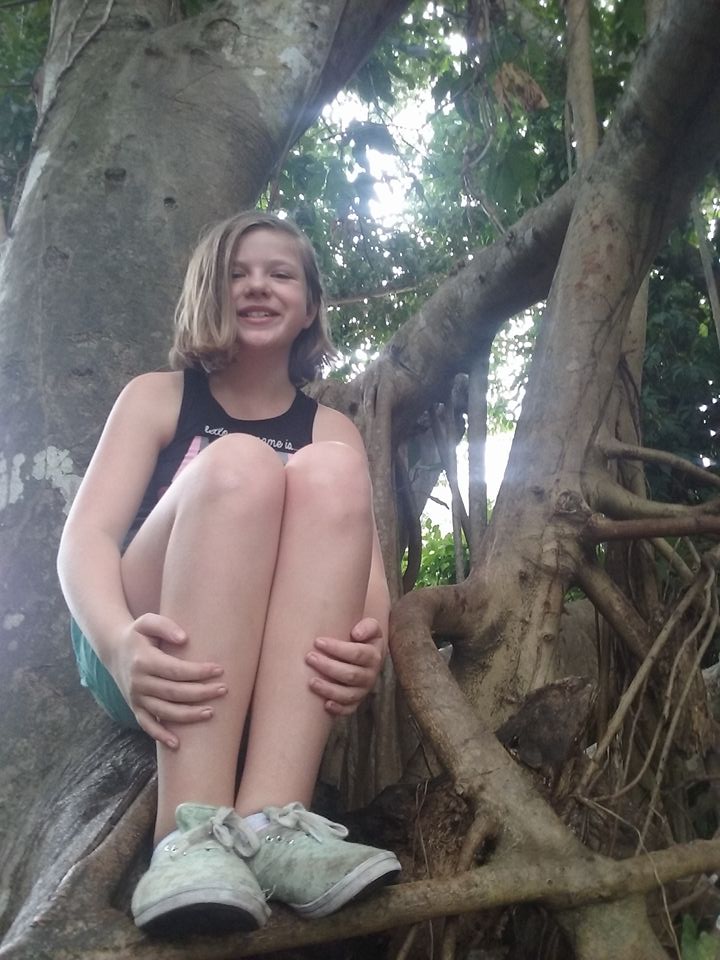
Tree climbing can be seen as a lesson in business planning.  You have to steady yourself, plan where to reach for and step next, and then do it.  Establish yourself and get a firm grip of where you are on the tree and reach for the next  branch.  In business, you get to a point, make your impact; and then prepare through market research, budgeting, and networking to go for the next level - and then you do it. 


Tree climbing can also be seen as PE. It is a great physical activity.  It also has a connection to environmental science just as the ocean (or in our case the Gulf) does.  And then there is the emotional component of how time in nature affects our mental health and psychological well being. 

            As a homeschooling parent, the philosophy of unschooling has helped me to be able to relax and to find value at times when I might otherwise have been stressed out that we weren’t doing “enough.”  I’m not suggesting that to learn about business planning the only thing one has to do is to go climb a tree.  I’m also not saying to turn the tree climbing experience into a lesson. What I am suggesting is maybe years later when the student is studying economics or developing an entrepreneurial plan, you might remind them of something like a tree climb in terms of planning and reaching for goals.  Or, you could just let the tree climb sit and if the student has made a connection to that particular endeavor, great – if not, no loss.  The joy and the fun of the climb is what mattered.   

Tuesday, November 21, 2017

How We Continue To Mesh Charlotte Mason, Waldorf, and Self-Directed Learning

            In a Charlotte Mason education, a lot of subjects are covered each day, but lessons are short.  At the beginning of this fifth grade school year, I wrote about my struggle to choose between doing it the traditional CM way and following a CM model schedule or working more from a block rotation schedule similar to what is done in Waldorf programs and schools.  I decided to go with the block rotation ala Waldorf, and I’m happy with that decision.      
We do writing, math, poetry, art appreciation, music appreciation, and ballet on a consistent basis, but rotate out history, literature, and science.  This doesn’t mean that she doesn’t learn any history or science during a literature block.  The point of doing things in a rotating block is so that we have less things to “check off.”  In a way, it’s more to help my sanity than anything else.  I’m not left with an empty nagging feeling of…”Oh Gawd….there’s so much we didn’t get done today.” 
For now, our block is literature. S is reading My Side Of The Mountain by Jean Craighead George.  Her cursive writing practice is being done through dictation and copywork. She works on typing and grammar practice through her written narrations.  We do rotate out cursive and typing practice. If she does a written narration one day, then she would do copywork and dictation on alternating days.  She is given about twenty-four math problems each day.  The artist for this term is Van Gogh. She just finished a biography on him.  The poem for this week is “Words To An Irish Air” by Aline Murray Kilmer. 
             
Aline Murray Kilmer

Just because our current block is literature, that doesn’t mean other topics aren’t discussed or covered in some manner.  S can read or do independent online “research” on a topic in science or whatever during her free time - and I’ll help her if she wants my help.  She is currently learning about the pirates Mary Read and Ann Bonny.  I didn’t assign this in any way. She found out about Read and Bonny from the internet and is running with it.  She also loves watching survival videos.  I do count her independent self-directed learning in her yearly logs.   This independent learning is not antithetical to the CM philosophy. In fact, it fits nicely with the CM idea that afternoons should be left free for individual pursuits and interests. 

Education As A Feast

 Charlotte Mason is often described as referring to education as a feast.  You (the teacher) prepare a feast for your child and the child fi...