Showing posts with label Unschooling. Show all posts

Thursday, February 8, 2018

If You’re Unschooling High School, You Might Want to Peek At Charlotte Mason

Truth be told, I think the Charlotte Mason approach to high school is more unschooly by far than what I’ve seen suggested on many unschooling pages. Dual enrollment seems to be the major recommendation for high schoolers.  Dual enrollment looks beyond fantastic on a college application, and it’s a great way to earn college credit for free.  But for those people who would prefer to continue to create their own high school curriculum free from textbooks and lesson plans, I feel that the CM method offers a lot of flexibility.
                One aspect of a Charlotte Mason education that seems to be unique is the practice of spreading out subjects over the years. In CM, a student does not take one year of Shakespeare study, but Shakespeare plays are read all throughout the high school years. Typically, a student would read three Shakespeare plays per year. This approach is used in both Ursa Minor (secular) https://ursaminorlearning.com/and Ambleside Online (religious Christian).  http://amblesideonline.org/  At the end of high school, you could grant your student one credit in Shakespeare for the work done throughout the years, or you could include each year’s Shakespeare readings under the umbrella of Literature along with the other books read.
                The study of economics is also spread out over four years.  The student reads books and essays over the course of four years instead of having one credit, or half a credit, crammed into a year or a semester.   I see this approach as being so friendly to unschooling because you are not locking yourself into learning about something for only one year. Or, if you do lose interest in something for a while and then become curious about it again, this approach allows you to weave in and out of learning about a specific topic.
                 The CM method is not in and of itself unschooling.  In fact, if you do approach it with the attitude really wanting a CM education, then there will be a certain rigor just by what subjects are covered in a CM setting.  Those subjects include art history, Shakespeare, poetry, Plutarch, along with the traditional subjects of history, literature, math, science, and foreign language.  I would think that an unschooler using a literature based learning approach would probably not do a study in all of these subjects. On the other hand, curiosity may be sparked and a student may choose to learn about Plutarch’s Lives.  That is something that goes back to that idea that education is a feast.  Lay the suggestions out before the student and allow them to decide how much they may want to tweak things.
                In many ways, CM’s approach to the rigorous subjects is so gentle that it really can be wonderful way for an unschooler to approach the subject.  For example, art history is learned by reading one or two books on art history spread out over four years.  Each year, three different artists and their work are studied. By studied, we mean read a biography or even a Wikipedia entry on the artist. Twelve of their pieces are closely observed and described by the student.  You could definitely be flexible with this and not necessarily study twelve pieces by the same artist. 
               I think that the major concern with combining unschooling with the CM method is one of credits.  It is really hard to measure credit hours in a CM education because many subjects are spread out over four years and also because one student might finish a book faster than another.  For that matter, a student might read a history book with a lot ease and then have to go slower on a science book – maybe even re-reading parts to gain a complete understanding.   If an unschooler learns about six artists, maybe that could be considered half a credit in art history instead of a full credit.  Or, should that study count for a full credit?  Also, I think a student could reasonably earn a full credit for Shakespeare by reading six plays instead of twelve. I asked a secular homeschooling facebook group how many Shakespeare plays they thought should be read for one credit solely in Shakespeare, and the average (and majority) of responses indicated that six plays would equal one high school credit.
             I’m not saying that all unschoolers should become Charlotte Mason homeschoolers.  I’m saying that I think unschoolers who want to continue to create their own education might find a lot of the CM methods to be very conducive to non-traditional study.  The books that are suggested by CM sites are just that – suggestions.  There are no textbooks or lesson plans in a CM education.  And again, it’s a feast. An unschooler could use the CM approach for economics and not read a single Shakespeare play.  It’s not all or nothing.  (However, if you are participating in a study on CM educated students then I would say that one would have to show that they really followed all of the methods in a Charlotte Mason education.)
                 

Saturday, December 2, 2017

What Unschooling Has Taught Me About the Value of an Experience

There are a lot of things that I like about unschooling and a lot of things about it that I disagree with. Ultimately, it is too dogmatic for me.  Yes, I think unschooling is dogmatic.  But let’s look at what I do like about it. One thing that unschooling has taught me is the importance of seeing value in otherwise unappreciated ventures.  For example, Seneca likes to play an online game called Roblox.  It had nothing to do with our homeschooling.   Anyhow, this year we recently started to implement Written Narrations where she writes a few sentences to a paragraph about what she has been reading.  She asked if she could type her narrations and I was actually glad she had asked to type them. I was worried that since she hadn’t done any practice with her online typing curriculum in about a year that she had lost her typing skills. I was quite wrong.  She sat down to write her narration and I heard that keyboard clicking away.  I asked her where she had learned to type so well, and that was when she told me it was from playing the online game Roblox.  She had learned this great skill, but not in an academic approach or set plan to learn typing.     
With the unschooling approach, simple everyday acts become seen through a new lens.  One of the better presentations on unschooling was a report done from Australia.  In the segment, the reporter states, “Research shows play stimulates problem solving, creativity, and imagination.  It also helps social skills including a child’s ability to compromise and cooperate.  And so, unschoolers place equal value on park days and academic learning.”https://www.youtube.com/watch?v=nwqMW3bQDro&t=375s
I would like to step out right now to say that of all the segments on unschooling that have been done in the US by American reporters not once was the issue of play addressed from a positive standpoint. The reporters never mentioned any research of the positive aspects of play.  To me that is very negligent reporting, and it’s unacceptable to be that negligent. 
I have come to see that a day at the beach is not just a recreational activity, but it is a learning activity. I do not turn it into a learning activity.  We don’t stop and study what we are seeing. But I know that the sand and water are providing sensory experiences.  A connection is being formed, so that when my kids do go to an event or pick up a book studying aquatic life they will be able to connect with the topic on a deeper level.
This is not to say that to study any particular subject, one must have some sort of direct personal experience with it.  Our experiences and connections come in all forms.  For my older kids, much of their love of history was initially sparked by movies set in different historical eras. From there, they did research on the people and events of the times. 
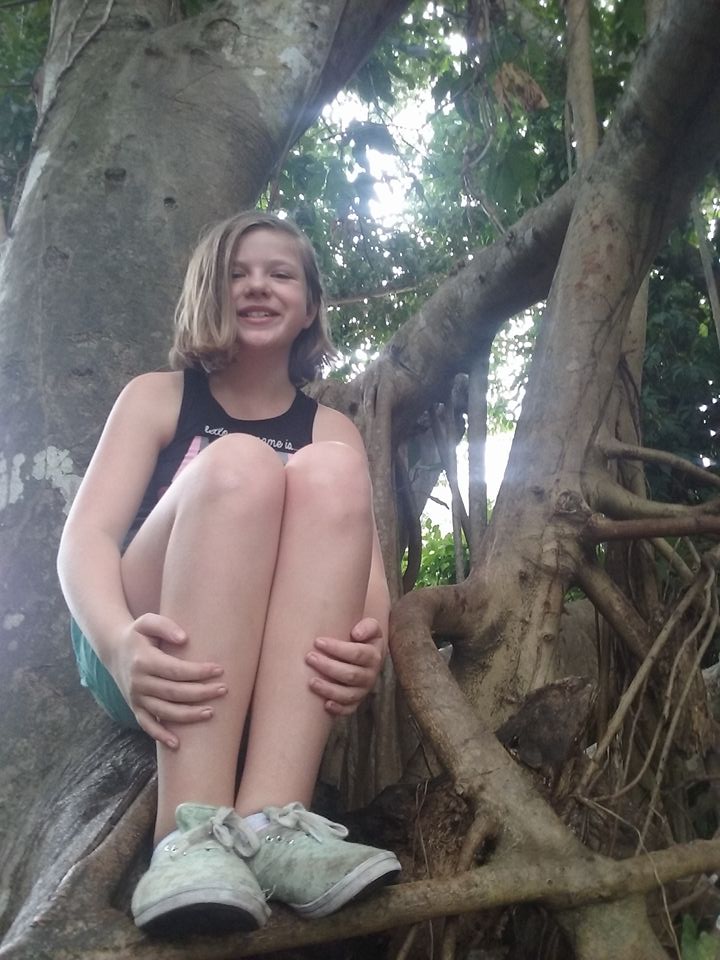
Tree climbing can be seen as a lesson in business planning.  You have to steady yourself, plan where to reach for and step next, and then do it.  Establish yourself and get a firm grip of where you are on the tree and reach for the next  branch.  In business, you get to a point, make your impact; and then prepare through market research, budgeting, and networking to go for the next level - and then you do it. 


Tree climbing can also be seen as PE. It is a great physical activity.  It also has a connection to environmental science just as the ocean (or in our case the Gulf) does.  And then there is the emotional component of how time in nature affects our mental health and psychological well being. 

            As a homeschooling parent, the philosophy of unschooling has helped me to be able to relax and to find value at times when I might otherwise have been stressed out that we weren’t doing “enough.”  I’m not suggesting that to learn about business planning the only thing one has to do is to go climb a tree.  I’m also not saying to turn the tree climbing experience into a lesson. What I am suggesting is maybe years later when the student is studying economics or developing an entrepreneurial plan, you might remind them of something like a tree climb in terms of planning and reaching for goals.  Or, you could just let the tree climb sit and if the student has made a connection to that particular endeavor, great – if not, no loss.  The joy and the fun of the climb is what mattered.   

Tuesday, November 21, 2017

How We Continue To Mesh Charlotte Mason, Waldorf, and Self-Directed Learning

            In a Charlotte Mason education, a lot of subjects are covered each day, but lessons are short.  At the beginning of this fifth grade school year, I wrote about my struggle to choose between doing it the traditional CM way and following a CM model schedule or working more from a block rotation schedule similar to what is done in Waldorf programs and schools.  I decided to go with the block rotation ala Waldorf, and I’m happy with that decision.      
We do writing, math, poetry, art appreciation, music appreciation, and ballet on a consistent basis, but rotate out history, literature, and science.  This doesn’t mean that she doesn’t learn any history or science during a literature block.  The point of doing things in a rotating block is so that we have less things to “check off.”  In a way, it’s more to help my sanity than anything else.  I’m not left with an empty nagging feeling of…”Oh Gawd….there’s so much we didn’t get done today.” 
For now, our block is literature. S is reading My Side Of The Mountain by Jean Craighead George.  Her cursive writing practice is being done through dictation and copywork. She works on typing and grammar practice through her written narrations.  We do rotate out cursive and typing practice. If she does a written narration one day, then she would do copywork and dictation on alternating days.  She is given about twenty-four math problems each day.  The artist for this term is Van Gogh. She just finished a biography on him.  The poem for this week is “Words To An Irish Air” by Aline Murray Kilmer. 
             
Aline Murray Kilmer

Just because our current block is literature, that doesn’t mean other topics aren’t discussed or covered in some manner.  S can read or do independent online “research” on a topic in science or whatever during her free time - and I’ll help her if she wants my help.  She is currently learning about the pirates Mary Read and Ann Bonny.  I didn’t assign this in any way. She found out about Read and Bonny from the internet and is running with it.  She also loves watching survival videos.  I do count her independent self-directed learning in her yearly logs.   This independent learning is not antithetical to the CM philosophy. In fact, it fits nicely with the CM idea that afternoons should be left free for individual pursuits and interests. 

Education As A Feast

 Charlotte Mason is often described as referring to education as a feast.  You (the teacher) prepare a feast for your child and the child fi...